
Ethernet switches play a central role in modern IEC 61850 substations. They connect protection relays, merging units, bay controllers, SCADA gateways, time servers, HMIs, and many more devices. If a switch fails or behaves incorrectly, the entire communication system can be affected. Because protection and control functions depend on fast and reliable data, a substation switch must meet very high requirements.
This article explains everything an engineer needs to know about switches in IEC 61850 substations. It covers the standards, environmental requirements, technical capabilities, redundancy behavior, network design rules, cybersecurity needs, and best practices for installation, testing, and long-term operation.
Table of Contents
Why Substation Switches Need Special Requirements
Substations are harsh environments for electronic equipment. High voltage devices create strong electromagnetic fields, fast electrical transients, and voltage spikes. Temperatures may be extreme, and equipment may face vibration, shock, dust, and humidity. In addition, the communication system carries time-critical protection messages that cannot be delayed or lost.
A normal industrial switch is not enough. A substation switch must be specially designed to stay stable under electrical noise, to continue forwarding messages during extreme events, and to support redundant IEC 61850 communication without interruption. This is why special standards and requirements exist.
IEC 61850-3: The Key Standard for Substation Switches
Any switch used in an IEC 61850 substation must follow IEC 61850-3.
This standard defines how the switch should behave in terms of:
- electrical immunity
- electromagnetic compatibility
- temperature range
- vibration and shock
- surge tolerance
- humidity and environmental stress
- long-term stable operation
IEC 61850-3 ensures that a switch continues working even during breaker operations, transformer energization, lightning disturbances, and strong electromagnetic fields. Without IEC 61850-3 compliance, a switch is not suitable for use in a substation.
Essential Technical Features for IEC 61850 Substation Switches
Switches used in IEC 61850 networks must support several important functions to ensure reliable operation.
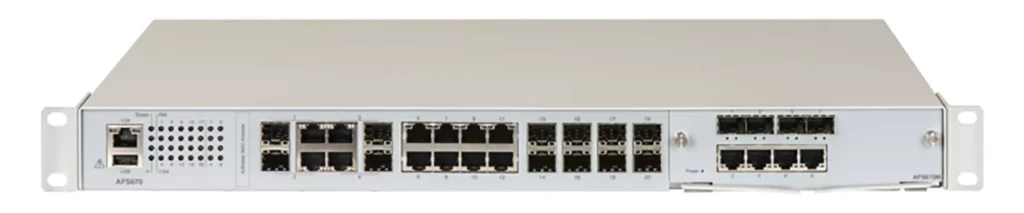
VLANs and QoS
The switch must support VLANs to separate different traffic types and Quality of Service (QoS) to ensure important messages are delivered first. GOOSE and Sampled Values must always have the highest priority, while engineering and SCADA traffic can be lower priority.
Support for PRP and HSR Traffic
IEC 61850 redundancy methods such as PRP and HSR rely on duplicated frames or ring forwarding. The switch does not run PRP or HSR itself, but it must forward these frames transparently. PRP frames contain a small trailer, and the switch must not modify or drop it.
Handling of GOOSE and Sampled Values (SV)
GOOSE and SV messages are multicast and must be forwarded quickly. A good substation switch must manage multicast efficiently, without flooding the network, and must avoid dropping or delaying traffic.
Low Latency and Non-Blocking Performance
Protection traffic cannot tolerate delays. The switch must forward frames at wire speed with very low and predictable latency. Even under high load, it must not block or delay traffic.
Time Synchronization Support (PTP/IEEE 1588v2)
Precise timing is essential for process bus systems. A substation switch should support PTP Transparent Clock or Boundary Clock functions to maintain timing accuracy across the network.
Rugged Hardware and Redundant Power
Substation switches must be mechanically strong, fanless, and able to operate in wide temperature ranges. They should have redundant power inputs to avoid outages and a long service life.
Cybersecurity Features
Switches must provide secure management access, authentication, logging, and protection against unauthorized use. Cybersecurity is critical because substations are essential infrastructure.
Environmental and EMC Requirements
IEC 61850-3 also ensures that switches can survive electrical disturbances such as electrostatic discharge, surges, fast transients, radiated electromagnetic fields, and high-frequency interference from high-voltage equipment. Switches are tested according to several IEC standards to ensure they remain stable in these conditions.
In addition to electrical immunity, the switch must withstand vibration, shock, and sometimes seismic activity. Over time, the switch must remain reliable even in harsh environments with dust, heat, cold, or humidity.
Station Bus vs. Process Bus Switches
Station bus switches handle messages like GOOSE, MMS, and event or status information. They require low latency but generally less traffic than process bus switches.
Process bus switches must handle Sampled Values and high-frequency timing data. These messages have much stricter requirements because they are produced continuously and at high rates. This means process bus switches must provide even lower latency, better multicast performance, and strong PTP timing support.
Both types of switches must follow IEC 61850-3, but process bus switches typically require higher performance.
Network Topology Considerations
IEC 61850 networks support many topologies. Star topologies are common because they are simple and easy to understand. Line and chain topologies may be used in long-distance installations but require careful design to avoid delays. Ring topologies are often used with HSR or other redundancy methods. In large substations, a combination of these topologies may be used to balance performance and reliability.
When PRP is used, LAN A and LAN B must be completely independent. This means using different switches, separate power feeds, and ideally separate physical routing for cables. This avoids common-mode failures that could impact both networks at once.
Management and Monitoring Features
To help operators maintain visibility of the network, a substation switch should support management tools such as SNMP for monitoring, Syslog for detailed logs, and port mirroring for diagnostics. Real-time counters, alarms, and event reporting make it easier to detect issues before they cause outages. These features help engineers understand network health and troubleshoot problems efficiently.
Firmware Lifecycle and Long-Term Availability
Substations are long-life infrastructures. Devices installed today must remain supported for 10 to 20 years or more. Because of this, firmware for substation switches must be stable and long-lived. The switch should not rely on frequent updates and should not require major hardware changes. Long-term product availability is essential so utilities can replace hardware without redesigning their network.
Installation Best Practices
Switches should be installed in a clean, ventilated area of the panel or rack, away from strong sources of electrical noise. Cabling should be routed carefully, and grounding and shielding should be done according to best practices to reduce interference. For PRP networks, cables belonging to LAN A and LAN B should never share the same conduit or tray. Fiber optic cables are often preferred for longer distances or in areas with high electrical noise.
Testing and Commissioning Requirements
Before the substation goes live, the switch must be tested for latency, redundancy behavior, multicast forwarding, and timing accuracy. GOOSE messages should be tested to confirm they are delivered within the required time. Sampled Values must be checked for loss and jitter. Redundancy networks such as PRP and HSR should be tested by disconnecting cables and observing the system response. Time synchronization should be verified using appropriate tools.
Commissioning tests ensure that the switch is working as expected before the substation is energized.
How to Choose the Right Switch for an IEC 61850 Substation
When choosing a switch, the most important requirement is IEC 61850-3 compliance. After that, the switch must offer reliable multicast handling, transparent PRP and HSR forwarding, VLAN and QoS support, low latency, time synchronization functions, redundant power, and strong cybersecurity. Engineers should also consider long-term availability and stability, so the switch remains reliable throughout the life of the substation.
Conclusion
Switches in IEC 61850 substations must meet high standards of reliability, performance, and robustness. They must handle time-critical protection messages, survive electrical disturbances, support redundancy methods, and remain stable for many years. IEC 61850-3 defines the requirements that make a switch suitable for use in such an environment. By choosing switches that meet these requirements and by following good design, installation, and testing practices, engineers can build substations that are safe, reliable, and ready for the future.