
In modern electrical power systems, maintaining voltage stability and controlling reactive power is critical — especially as grids become more complex with increased renewable energy and variable loads. One advanced solution used widely by power engineers is STATCOM, short for Static Synchronous Compensator — a key device in the family of Flexible AC Transmission System (FACTS) technologies.
Table of Contents
What Is STATCOM?
A STATCOM is a power electronic device that provides dynamic reactive power compensation to the electrical grid. Unlike traditional mechanical equipment, STATCOMs have no moving parts, which gives them very fast response times (on the order of milliseconds).
At its core, a STATCOM:
- Regulates voltage
- Improves power factor
- Reduces harmonic distortion
- Enhances overall system stability
These functions are especially important when dealing with weak grids, fluctuating loads, or high penetration of inverter-based generation such as solar and wind power.
How STATCOM Works
The operation of a STATCOM is based on comparing its internal voltage to the grid voltage:
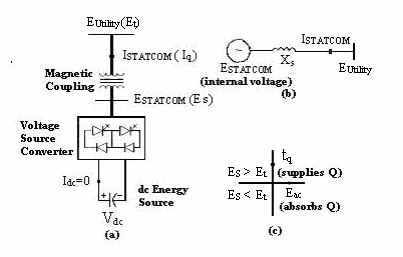
- If the STATCOM’s internal voltage (V_STATCOM) is higher than the grid voltage (V_GRID)(Es > Et), it supplies reactive power to the system (capacitive mode).
- If V_STATCOM is lower (Es < Et), the STATCOM absorbs reactive power from the grid (inductive mode).
- If the two voltages are equal, there is no exchange of reactive power.
This dynamic exchange allows the device to rapidly adjust reactive power flow as system conditions change, supporting stable voltage levels across the network.
Main Components of a STATCOM
A STATCOM consists of several key parts:
- Voltage Source Converter (VSC)
Converts DC (direct current) into controlled AC (alternating current) with adjustable magnitude and phase. - DC Link Capacitor
Provides the DC voltage that feeds the converter. - Coupling Transformer or Reactor
Connects the converter to the grid and allows transfer of reactive power. - Control System
Regulates voltage, current, and reactive power in real time based on grid conditions.
STATCOM vs SVG
Often, you’ll hear the term SVG — Static VAR Generator. Technically, an SVG and STATCOM are very similar in functionality. The main difference tends to be naming conventions rather than operation:
- STATCOM is the standard IEEE term.
- SVG is a commercial or manufacturer term.
Both use voltage source converters to dynamically provide or absorb reactive power, adapting to grid requirements.
Why STATCOM Matters in Power Systems
Reactive power does not perform useful work, but it is essential for maintaining voltage levels and power quality. Without proper reactive power management:
- Voltage can collapse during high load conditions.
- System stability can degrade.
- Operational limits of generators and transformers can be exceeded.
The STATCOM’s ability to respond quickly — much faster than mechanical devices — makes it an essential tool in modern power grids that must handle rapid changes and maintain reliability.