
Digital substations rarely use a single redundancy method everywhere. In practice, different parts of the substation have different requirements. Protection IEDs and merging units on the process bus often use HSR because it offers a simple ring structure and zero-time recovery for Sampled Values and GOOSE messages. Meanwhile, station bus networks, SCADA connections, and backbone communication often rely on PRP because it uses two independent networks and allows interoperability with standard Ethernet switches.
Because of these different needs, real substations frequently combine PRP and HSR within the same architecture. Devices on the process bus may operate inside HSR rings, while bay controllers and station-level equipment communicate over PRP networks. To make these heterogeneous redundancy domains work together, engineers use special interconnection nodes such as RedBoxes and QuadBoxes. These devices act as translators and allow equipment using different redundancy mechanisms to participate in a unified IEC 61850 communication environment.
This article explains how PRP and HSR are interconnected, how RedBoxes and QuadBoxes operate, how hybrid architectures are designed, and how migration strategies are implemented in real substations. The goal is to give engineers a clear technical understanding of how seamless redundancy is maintained across multiple redundancy technologies.
Table of Contents
Two Redundancy Models, One Substation
PRP and HSR both offer zero-time recovery but achieve this in different ways. PRP uses two parallel networks (LAN A and LAN B). Each PRP device injects two identical frames into the network, one into each LAN. The receiving device accepts the first one and discards the second. Since each LAN is completely independent, the failure of one does not affect the other.
HSR operates differently. It uses a single network arranged in a ring. Every device has two ports and forwards frames. A frame is duplicated and sent clockwise and counterclockwise. If any link fails, the frame still arrives from the other direction.
Because these two redundancy models operate on different principles, they cannot directly exchange traffic without a translator. A PRP device cannot decode HSR tags, and an HSR device cannot interpret PRP LAN identifiers. Without a translation layer, Sampled Values, GOOSE, or MMS traffic would not be understood or would be duplicated in inconsistent ways.
This is where RedBoxes and QuadBoxes play a central role. They allow seamless communication between PRP and HSR domains without breaking the zero-time recovery concept.
RedBoxes as the Bridge Between PRP and HSR
A RedBox is an intelligent gateway used to connect non-HSR or non-PRP devices into a redundancy domain. RedBoxes exist in both PRP systems and HSR systems, but their role becomes especially important when the two redundancy technologies must interoperate.
A PRP-HSR RedBox has multiple responsibilities. It must appear to the HSR ring as a fully compatible HSR node and to the PRP network as a fully compatible PRP device. It also represents devices on one redundancy domain inside the other. For example, a RedBox connected to a PRP device must generate the necessary HSR frames on behalf of that device when communicating in an HSR ring.
Internally, the RedBox contains duplicate detection tables, forwarding logic, and redundancy control mechanisms for both PRP and HSR. When it receives traffic from a PRP device, it extracts the payload, generates the appropriate HSR frame with the proper HSR tag, duplicates the traffic as required, and sends it around the ring. When the RedBox receives an HSR frame from the ring, it removes the HSR tag, checks duplicates, and reinjects the traffic into the PRP domain through both LAN A and LAN B.
This translation is fully seamless. Devices on both sides behave as if they were communicating within their native redundancy environment. No special configuration is required in the connected devices.
QuadBoxes and Multi-Ring Interconnection
QuadBoxes are used to interconnect two HSR rings while maintaining seamless redundancy. However, they also play an important role when mixing PRP and HSR domains. A QuadBox offers four redundant HSR connections, allowing traffic from one ring to be forwarded into another. When combined with PRP-capable ports, QuadBoxes can form the central bridging point in multi-ring architectures.
In large substations, merging units in each bay may be arranged in their own HSR ring. These rings can then be connected through QuadBoxes to a station-level PRP backbone. Traffic from one ring is forwarded into the backbone or into other rings only when necessary, keeping most traffic local to its bay. This reduces load, forwarding delay, and complexity.
Although QuadBoxes are mainly designed for HSR-to-HSR interconnection, they often coexist with RedBoxes in hybrid architectures. The combination allows PRP, HSR, and standard Ethernet segments to operate together as a unified redundancy system.
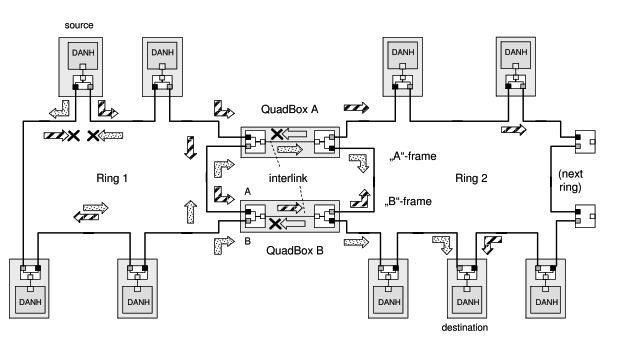
How Traffic Flows Between PRP and HSR Domains
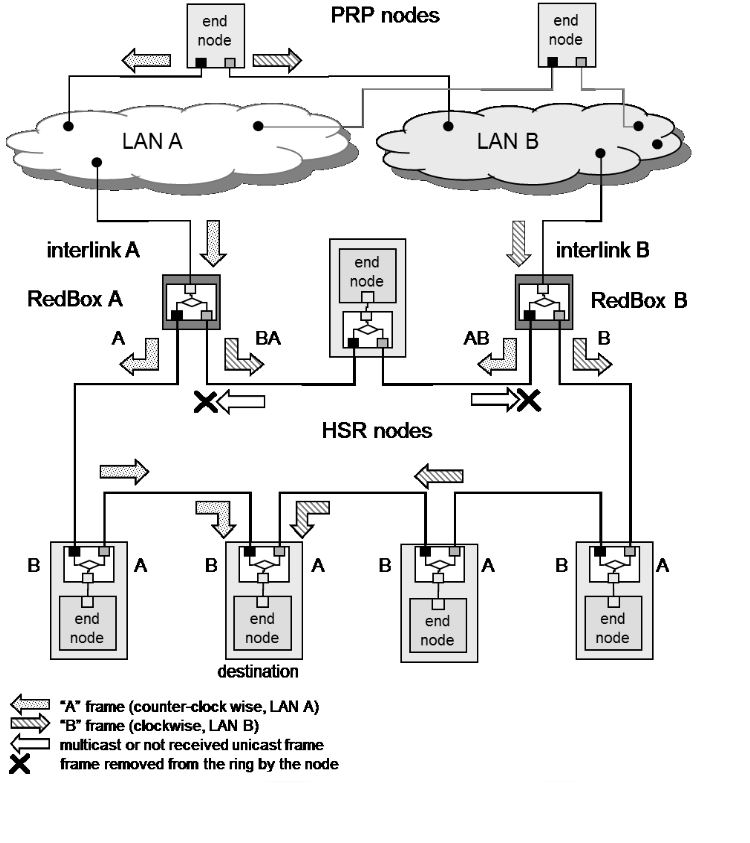
Understanding how frames move between domains is important for designing stable architectures. When a frame originates in a PRP device, the PRP stack generates two identical frames, one for each LAN. These frames arrive at the RedBox, which removes the PRP redundancy information. The RedBox then inserts the appropriate HSR header, assigns a sequence number, duplicates the frame, and injects it into the HSR ring. From that point on, the frames behave like any other HSR traffic.
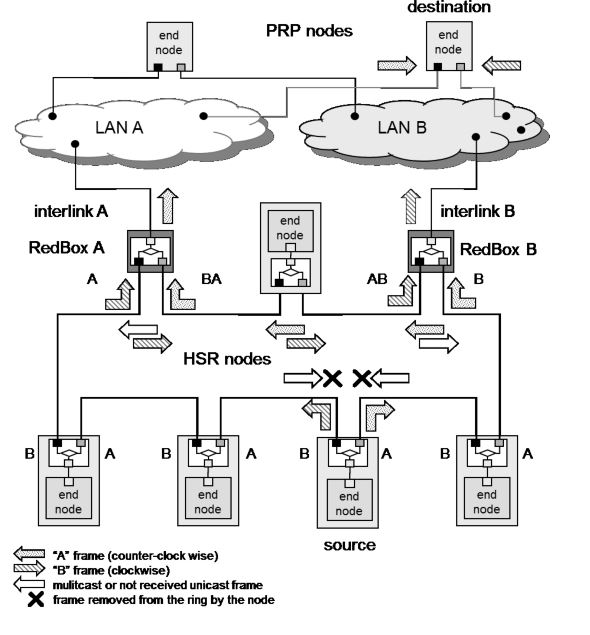
In the opposite direction, when a frame originates from an HSR device, it reaches the RedBox from one or both directions of the ring. The RedBox removes the HSR header, performs duplicate filtering, and generates two PRP frames. These frames are then sent into LAN A and LAN B simultaneously. A PRP device connected to the PRP side of the RedBox receives these frames just like any other PRP traffic.
This translation preserves redundancy behavior across the boundary. The delay introduced by the RedBox is predictable and designed not to disrupt time-critical traffic like Sampled Values or GOOSE messages.
Using PRP for Station Bus and HSR for Process Bus
A common architecture in digital substations uses HSR at the process level and PRP at the station level. Merging units form HSR rings inside the switchyard to send Sampled Values to protection IEDs. Because HSR uses just one ring, it simplifies installation in the yard where distances are short and equipment is distributed.
Meanwhile, the station bus often uses PRP. SCADA systems, bay controllers, event recorders, and time servers benefit from PRP’s ability to use standard Ethernet switches and operate across longer distances. This provides high availability without requiring specialized hardware everywhere.
RedBoxes are then placed at the interface between the two domains. Protection relays may connect directly to both the HSR ring (to receive Sampled Values) and the PRP domain (to communicate with SCADA). Some relays act as dual-network devices, effectively reducing the number of required RedBoxes.
This multi-layered redundancy design matches the physical and functional requirements of modern substations. The process bus focuses on high-speed deterministic communication. The station bus focuses on flexibility, scalability, and integration with control center systems.
Coexistence of PRP and HSR in Large Substations
Large substations often contain multiple HSR rings. For example, each bay may have its own ring containing merging units, protection relays, and process interfaces. These rings do not always need to communicate with one another directly. Instead, each ring connects to a PRP network through a RedBox. The PRP network acts as the high-availability backbone of the substation.
This arrangement provides several benefits. Each ring becomes a self-contained unit. Failures inside one ring do not affect others. Traffic remains localized within each bay. When Sampled Value traffic increases due to system expansion or higher sampling rates, it affects only the local ring and not the entire substation.
At the same time, PRP’s dual LAN structure ensures that SCADA, event recorders, automation servers, and control center gateways always have uninterrupted connectivity. Using PRP for the backbone and HSR for the process bus allows the substation to take advantage of the strengths of each method.
Time Synchronization Across Mixed PRP–HSR Architectures
Time synchronization must operate consistently across both redundancy domains. Whether the substation uses PTP or other timing sources, the timing packets must pass seamlessly through RedBoxes and QuadBoxes. These devices must not distort timing information or introduce unpredictable delays.
In PRP networks, timing messages are duplicated like any other frame. In HSR networks, they circulate around the ring in both directions. When a RedBox connects the two domains, it must manage timing frames carefully. This includes forwarding the correct version of the message and ensuring that duplicate filtering does not interfere with the timing protocol.
When Boundary Clocks or Transparent Clocks are used, their roles must be coordinated across the domains. Process bus rings may use Boundary Clocks to stabilize timing close to merging units, while PRP networks may distribute time across both LANs using Transparent Clocks. The interaction must be tested to ensure stable synchronization throughout the substation.
Performance and Load Considerations
Traffic flow in hybrid PRP–HSR networks must be handled with attention to bandwidth, delay, and forwarding capacity. In HSR, every frame is duplicated and forwarded by every node. In PRP, traffic is duplicated into two separate networks. When connecting these two domains, careless design can lead to excessive traffic amplification.
Engineers should avoid placing too many non-HSR devices behind a single RedBox. They should also avoid forwarding high-bandwidth Sampled Values into the PRP network unless absolutely required. Ideally, Sampled Values remain within the HSR ring, and only protection decisions or processed data are forwarded upward.
Traffic shaping, VLAN tagging, and rate control help maintain stability. Critical frames such as GOOSE and Sampled Values require top priority in both domains. Timing messages must also be given highest priority. Meanwhile, engineering traffic and SCADA polling should be assigned lower priority.
Migration Strategies from Legacy Networks
Many existing substations still use legacy Ethernet redundancy mechanisms or even no redundancy at all. When migrating to digital substations, utilities often face a phased transition. RedBoxes and hybrid PRP–HSR designs support this type of migration.
A substation may begin by adding HSR rings for new bays while keeping the rest of the network running on traditional Ethernet. RedBoxes connect the new digital bays to the existing station bus. Over time, the station bus can be upgraded to PRP without disrupting the process-level HSR rings.
This step-by-step approach minimizes downtime and allows utilities to upgrade equipment gradually. It also allows integration of older protection relays and merging units that do not support redundancy natively. As these devices are replaced with modern ones supporting PRP or HSR, the architecture gradually becomes more robust.
Fault Scenarios in Combined Networks
When a link fails inside an HSR ring, traffic continues immediately in the opposite direction. When a link fails inside a PRP LAN, traffic continues on the remaining LAN. When the fault occurs at the boundary between PRP and HSR, the redundancy mechanisms on both sides must behave correctly.
RedBoxes and QuadBoxes handle these transitional situations by ensuring that traffic always has at least one available path. If both links of an HSR node fail, the ring becomes broken. In this case, communication still continues within each segment of the ring, but full redundancy is temporarily lost. If PRP LAN A fails, all devices automatically rely on LAN B.
Because both redundancy domains operate independently, failures remain isolated. A badly designed network can leak failures across domains, but a well-engineered PRP–HSR architecture keeps each failure local and maintains overall system stability.
Engineering Recommendations
Hybrid redundancy domains require careful planning. The number of HSR nodes in each ring should be limited to reduce delay. RedBoxes should not become overloaded by too many attached devices. PRP networks should be designed with clear physical separation between LAN A and LAN B to prevent common-mode failures.
Fiber cabling is preferred for both domains to reduce electromagnetic interference and maintain stable delay characteristics. Traffic segmentation using VLANs helps keep critical communications isolated. Supervisory functions should be continuously monitored, including ring health, PRP LAN status, and redundancy table entries.
Regular testing is essential. Engineers should simulate link failures on both HSR and PRP sides, verify that timing remains stable, and check that GOOSE and Sampled Values continue flowing without interruption. These tests confirm that the hybrid architecture delivers true seamless redundancy.
Conclusion
Interconnecting PRP and HSR within the same digital substation allows utilities to build scalable, reliable, and future-ready architectures. The combination of HSR rings at the process level and PRP networks at the station level leverages the strengths of both redundancy methods. RedBoxes and QuadBoxes provide seamless translation and maintain continuous operation across domains.
This hybrid approach aligns naturally with IEC 61850 principles. It provides zero-time recovery, predictable performance, strong interoperability, and the ability to integrate legacy equipment during migration. With proper engineering, PRP–HSR architectures create robust communication systems fully prepared for advanced automation, protection, and monitoring applications.